







01dragonslayer
Veteran
- Aug 25, 2016
- 7,726
- 545
More than half of all U.S. adults (58%) feel that reducing crime should be a top priority for the government. However, while crime rates have drastically dropped over the past 30 years, Americans consistently report feeling like crime is on the rise. This could be due to notable spikes in violent crime over the years, such as in 2020, when the U.S. saw its largest single-year increase (30%) in murders.
But how common are violent crimes and other crimes against persons in the United States? Which states are the safest, and which are the most dangerous? To answer these questions and others, we analyzed crime statistic data from the FBI's National Incident-Based Reporting System (NIBRS) to rank states across the country.
The FBI’s Uniform Crime Reporting (UCR) Program has provided crime statistics since 1930 and relies on the voluntary participation of law enforcement agencies nationwide to generate reliable crime data and reveal trends.
In January 2021, the UCR Program transitioned to exclusively using NIBRS, a more comprehensive data collection system. NIBRS gathers detailed information on each crime incident and its offenses, categorized into crimes against persons, crimes against property, and crimes against society.
This study focuses on crimes against persons reported through NIBRS in 2022 and uses that data to rank the most and least dangerous states across the U.S.
However, law enforcement agency participation rates vary widely by state, and a quarter of the country’s population wasn’t accounted for in 2022. This means that, while the information is still very valuable, the FBI’s crime data is incomplete and can’t paint an entirely accurate picture of the status of crime.
According to the 2022 UCR participation data available through the FBI’s Crime Data Explorer, 22,113 law enforcement agencies across the 50 U.S. states participated, but only 13,295 — or 60.1% — of them reported crime data through the NIBRS. That 60.1% of agency participation covers just over 75% of the national population. But it turns out that some states are far better at reporting than others. The chart below illustrates how agency participation varies by state. States with higher agency participation generally cover more of the population, though there is some noteworthy variation.

According to UCR participation data for 2022, the five states that performed the best in agency participation to report crime data were:
And the five states that performed the worst in agency participation to report crime data were:
The difference in agency participation and subsequent population coverage among states is staggering. A vast majority of U.S. states covered at least 50% of their population in their crime reporting. Notably, West Virginia and Louisiana — states with some of the worst rates of agency participation in data reporting — still contribute data covering much more than 50% of their populations (effectively covering a larger share of their population than states like California, Alaska, Mississippi, and New Jersey). Only Pennsylvania, Florida, and New York fall under the 50% population coverage mark, with less than 20% agency participation. In our previous version of this study, Florida wasn’t included because the state did not report any crime data to the FBI for the specified time period.
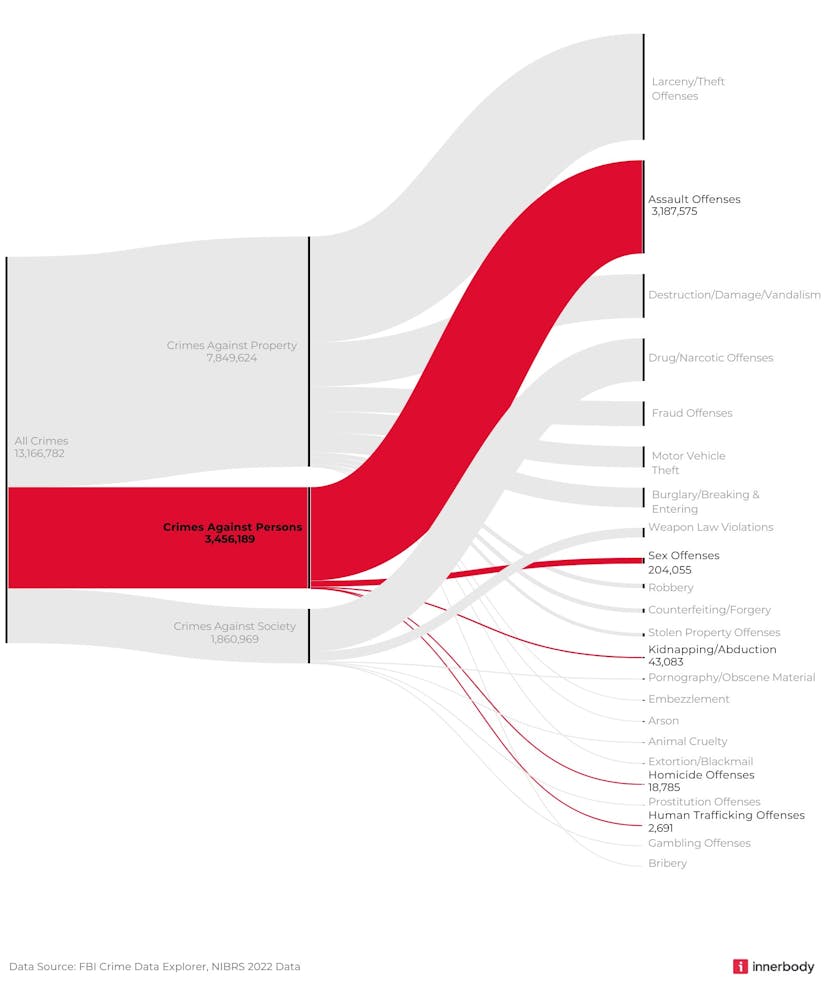
A crime against persons is any crime where the victims “are always individuals.” For each incident reported through the NIBRS, there may be one or more offenses (a new offense is counted for each victim harmed).
Crimes against persons include the following offenses:
Assault offenses: Includes aggravated assault, simple assault, and intimidation. These are the most common crimes against persons, totaling over three million incidents in 2022.
Sex offenses: Includes rape, sodomy, sexual assault with an object, fondling, incest, and statutory rape.
Kidnapping or abduction: Kidnapping involves unlawful restraint by force; abduction may involve force, persuasion, or fraud.
Homicide offenses: Includes murder, negligent manslaughter, and justifiable homicide.
Human trafficking offenses: Includes commercial sex acts and involuntary servitude.
Note: If you believe you or someone you know may be a victim of human trafficking, you are not alone — help is available.
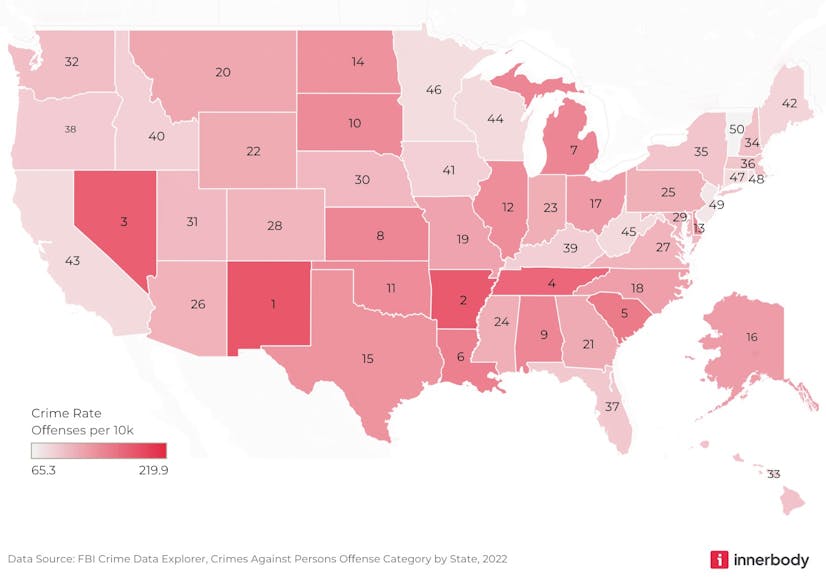
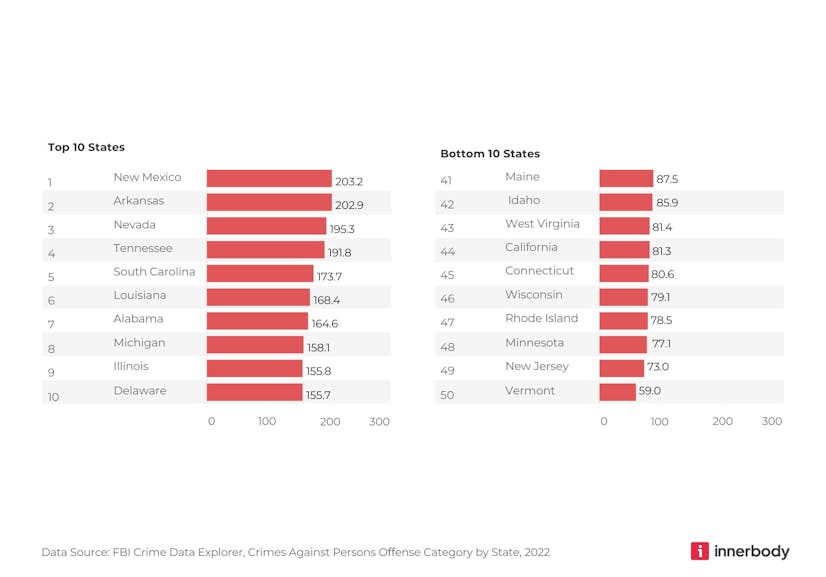
For both the safest and most dangerous states in the U.S., last year’s runner-ups have claimed the top spots. New Mexico has overtaken Nevada as the most dangerous state, while New Jersey took the crown from Vermont for being the safest state.
Top 10 Safest States:
Top 10 Most Dangerous States:
The South continues to struggle the most with violent crime, while the East Coast remains the safest region overall.
The top 10 assault and homicide states mostly match the overall top 10 most dangerous states. Delaware stands out as the only East Coast state in that top 10 list for violent offenses.
The central U.S. struggles most with human trafficking, kidnapping, and sex offenses.
But how common are violent crimes and other crimes against persons in the United States? Which states are the safest, and which are the most dangerous? To answer these questions and others, we analyzed crime statistic data from the FBI's National Incident-Based Reporting System (NIBRS) to rank states across the country.
Key takeaways
- []New Mexico has the country's highest rate of crimes against persons, while Vermont has the lowest. []Assault offenses accounted for 92.2% of the nearly 3.5 million reported crimes against persons in 2022. []The South has the highest rate of assault and homicide crimes, while the Central U.S. is struggling with human trafficking and sex offense crimes. []The East Coast has the lowest rate of crimes against persons, with Delaware being the only state in the region to be in the top 10 Assault and Homicide crimes list, despite the state’s recent gun safety legislation.
- Minnesota, West Virginia, Wisconsin, California, and Iowa are new states on this year's safe list, while Louisiana, Michigan, and Kansas are newcomers to the dangerous list.
Overview
For the 2024 update of our study on crimes against persons across the U.S., we used the latest data from the FBI's National Incident-Based Reporting System (NIBRS), which includes statistics up to the year 2022.The FBI’s Uniform Crime Reporting (UCR) Program has provided crime statistics since 1930 and relies on the voluntary participation of law enforcement agencies nationwide to generate reliable crime data and reveal trends.
In January 2021, the UCR Program transitioned to exclusively using NIBRS, a more comprehensive data collection system. NIBRS gathers detailed information on each crime incident and its offenses, categorized into crimes against persons, crimes against property, and crimes against society.
This study focuses on crimes against persons reported through NIBRS in 2022 and uses that data to rank the most and least dangerous states across the U.S.
National participation in crime reporting
The data provided by the FBI’s Uniform Crime Reporting (UCR) Program has become one of the country’s leading social indicators. For example, earlier this year, President Biden released a statement referencing an overall decrease in violent crimes based on preliminary data provided by the FBI’s UCR Program. Crime is one of the top cultural issues impacting voters' opinions for the 2024 election, and this data is being used to discuss the status of crime in the country.However, law enforcement agency participation rates vary widely by state, and a quarter of the country’s population wasn’t accounted for in 2022. This means that, while the information is still very valuable, the FBI’s crime data is incomplete and can’t paint an entirely accurate picture of the status of crime.
According to the 2022 UCR participation data available through the FBI’s Crime Data Explorer, 22,113 law enforcement agencies across the 50 U.S. states participated, but only 13,295 — or 60.1% — of them reported crime data through the NIBRS. That 60.1% of agency participation covers just over 75% of the national population. But it turns out that some states are far better at reporting than others. The chart below illustrates how agency participation varies by state. States with higher agency participation generally cover more of the population, though there is some noteworthy variation.
According to UCR participation data for 2022, the five states that performed the best in agency participation to report crime data were:
- []Rhode Island (96%) []Oklahoma (89.7%) []Virginia (89.1%) []Oregon (88.0%)
- New Hampshire (86.9%)
And the five states that performed the worst in agency participation to report crime data were:
- []Pennsylvania (7.1%) []Florida (8.8%) []New York (16.5%) []West Virginia (45.3%)
- Louisiana (47.0%)
The difference in agency participation and subsequent population coverage among states is staggering. A vast majority of U.S. states covered at least 50% of their population in their crime reporting. Notably, West Virginia and Louisiana — states with some of the worst rates of agency participation in data reporting — still contribute data covering much more than 50% of their populations (effectively covering a larger share of their population than states like California, Alaska, Mississippi, and New Jersey). Only Pennsylvania, Florida, and New York fall under the 50% population coverage mark, with less than 20% agency participation. In our previous version of this study, Florida wasn’t included because the state did not report any crime data to the FBI for the specified time period.
What is a crime against persons?
In 2022, the law enforcement agencies that participated in the National Incident-Based Reporting System (NIBRS) program reported 13,166,782 total offenses. Of these, 3,456,189 offenses were considered crimes against persons.
A crime against persons is any crime where the victims “are always individuals.” For each incident reported through the NIBRS, there may be one or more offenses (a new offense is counted for each victim harmed).
Crimes against persons include the following offenses:
Assault offenses: Includes aggravated assault, simple assault, and intimidation. These are the most common crimes against persons, totaling over three million incidents in 2022.
Sex offenses: Includes rape, sodomy, sexual assault with an object, fondling, incest, and statutory rape.
Kidnapping or abduction: Kidnapping involves unlawful restraint by force; abduction may involve force, persuasion, or fraud.
Homicide offenses: Includes murder, negligent manslaughter, and justifiable homicide.
Human trafficking offenses: Includes commercial sex acts and involuntary servitude.
Note: If you believe you or someone you know may be a victim of human trafficking, you are not alone — help is available.
Which U.S. states are the safest and most dangerous?
Here is a map ranking U.S. states based on the rate of crimes against persons.
For both the safest and most dangerous states in the U.S., last year’s runner-ups have claimed the top spots. New Mexico has overtaken Nevada as the most dangerous state, while New Jersey took the crown from Vermont for being the safest state.
Top 10 Safest States:
- []Vermont []New Jersey []Rhode Island []Connecticut []Minnesota []West Virginia []Wisconsin []California []Maine []Iowa
Top 10 Most Dangerous States:
- []New Mexico []Arkansas []Nevada []Tennessee []South Carolina []Louisiana []Michigan []Kansas []Alabama []South Dakota
The South continues to struggle the most with violent crime, while the East Coast remains the safest region overall.
Most common crimes against persons by state
In order to provide a better picture of which crimes against persons are most common across the United States, we broke down the FBI’s data into two categories:- []Assault and homicide offenses []Human trafficking, kidnapping, abduction, and sex offenses
The top 10 assault and homicide states mostly match the overall top 10 most dangerous states. Delaware stands out as the only East Coast state in that top 10 list for violent offenses.
The central U.S. struggles most with human trafficking, kidnapping, and sex offenses.




